
Find Texas Probate Court Records Online
Texas probate court records are kept at the county level across all 254 counties. These files cover wills, estate cases, guardianship orders, heirship findings, and mental health matters. Each county clerk or statutory probate court holds the case files for that area. You can search many of them online through county portals or the statewide eFileTexas system. Some counties let you look up case data for free, while others need you to call or visit in person. If you want to find a specific probate case, start with the county where the person lived at the time of death. The clerk there can pull the file by name or case number and make copies for you.
Texas Probate Court Records Overview
Where to Find Texas Probate Court Records
The County Clerk's office is the main place to look for probate court records in Texas. Each of the 254 counties has a clerk who keeps the full case file for every probate matter filed there. That file holds the will, the application for probate, letters testamentary, estate inventories, court orders, and the final accounting. The clerk can search by name or case number and make copies. Larger counties like Harris, Dallas, Bexar, and Travis have their own statutory probate courts with dedicated judges and staff who handle only probate and guardianship cases.
Texas also has state-level resources that can help you track down probate court records. The Office of Court Administration runs the official court system website and keeps statistics on probate filings across every county. The Texas Judicial Branch Court Activity Database has data on probate cases filed and disposed going back to September 1992. You can run reports for a single county or pull statewide totals. It is free to use.
The screenshot below shows the Texas Judicial Branch Court Activity Database where you can search probate case statistics by county.
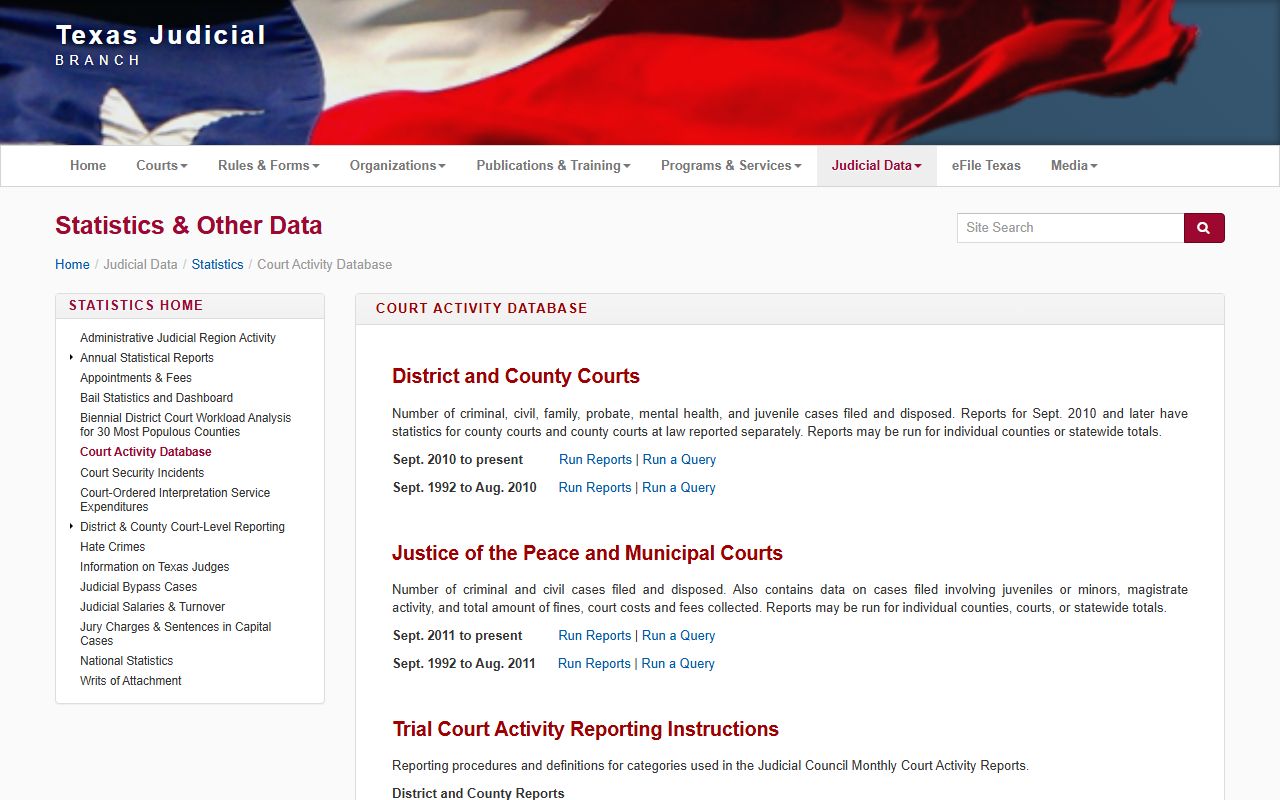
This portal lets you filter by case type, date range, and specific county to see how many probate matters were filed and resolved.
Note: Probate court records in Texas are public under Texas Government Code Chapter 552. Anyone can ask the county clerk for copies without giving a reason.
How to Search Probate Court Records in Texas
Start by figuring out which county the person lived in when they died. That is where the case was filed. Under Texas Estates Code Chapter 51, probate proceedings go in the county where the decedent resided. Once you know the county, you can search online or visit in person.
Many Texas counties offer free online searches for probate court records. Harris County runs a probate portal at probate.harriscountytx.gov that covers all five of its statutory probate courts. Dallas County has a case portal where you can search by name or case number without an account. Travis County puts case data from June 1986 to the present online, with document images from December 2005 forward. Tarrant County uses an Odyssey-based system for case searches. These are just a few examples. Smaller counties may have limited online access, so calling the clerk is sometimes the best option.
The eFileTexas system is the statewide electronic filing portal. Attorneys must use it for probate filings. The system also gives some public access to filed documents depending on the county. For questions about eFileTexas, call 855-839-3453.
The Office of Court Administration page for rules and forms is shown below.
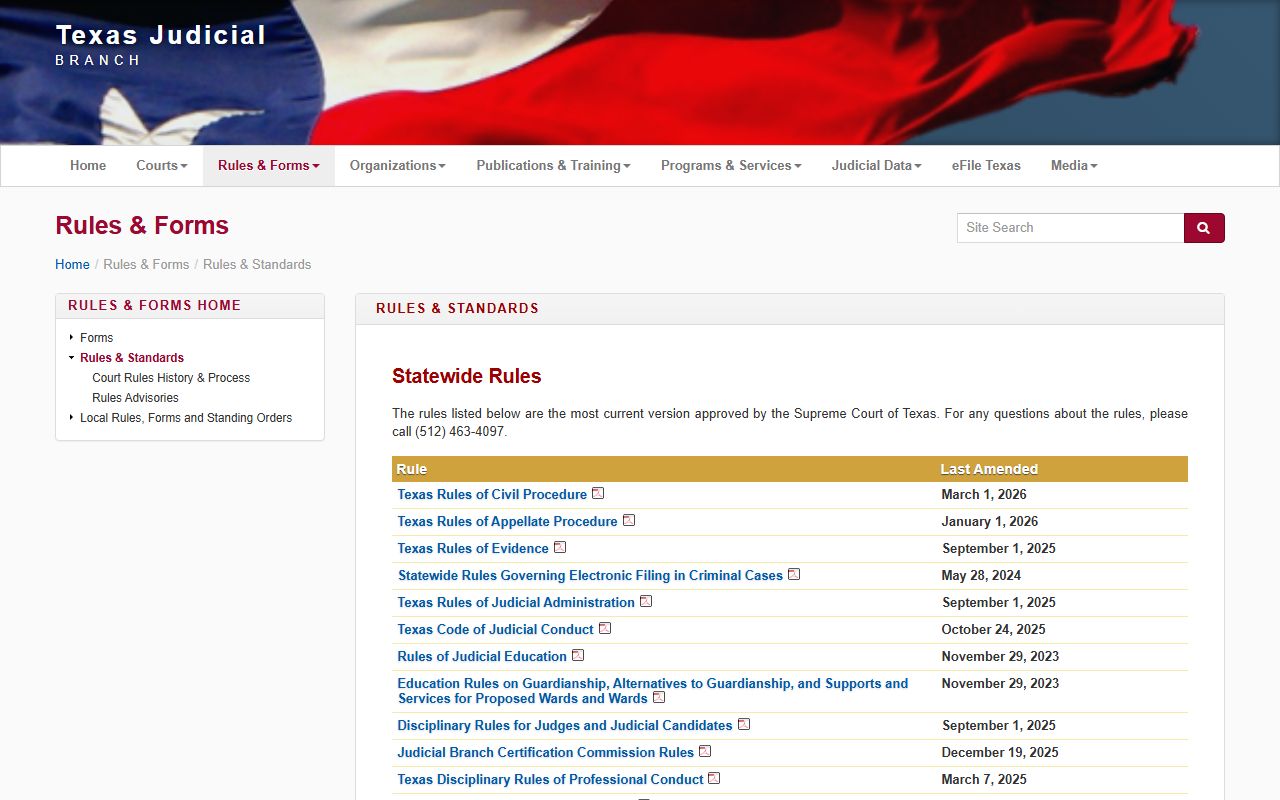
Local rules, forms, and standing orders for individual courts are posted on this site as required by Texas Rule of Civil Procedure 3a.
Types of Texas Probate Court Records
Probate court records in Texas cover several kinds of cases. The most common is the probate of a will. When someone dies with a will, the executor files it with the county clerk along with an application to probate. The court then admits the will and issues letters testamentary, which give the executor legal power to act on behalf of the estate. Under Texas Estates Code Chapter 257, most Texas estates go through independent administration. This means less court oversight and fewer filings than a dependent administration.
When no will exists, the court handles an heirship proceeding under Texas Estates Code Chapter 304. The court determines who the legal heirs are and may appoint an administrator. Another option is probate as muniment of title under Chapter 256. This simpler path works when no administration is needed and the goal is just to transfer property. No executor is appointed.
A probate case file in Texas often includes:
- The original will and any codicils
- Application to probate the will
- Letters testamentary or letters of administration
- Inventory and appraisement of estate assets
- Claims filed by creditors
- Court orders and final accounting
Small estates worth under $75,000 (not counting the homestead) can use a Small Estate Affidavit under Texas Estates Code Section 205. All heirs sign the affidavit. It goes to the county clerk with a filing fee of $250 to $400 depending on the county. Once approved, the affidavit works like a court order for collecting assets from banks and other holders.
Texas Estates Code and Probate Court Records
The Texas Estates Code took effect on January 1, 2014, replacing the old Texas Probate Code. It covers the full range of estate and guardianship law. Chapter 22 defines key terms like "estate," "probate," "guardian," and "ward." The code has four main titles: General Provisions, Estates of Decedents, Guardianship, and Transitional Provisions.
Probate courts in Texas sit at the county level. In larger counties, a statutory probate court handles these cases exclusively. Smaller counties assign probate matters to the constitutional county court or a county court at law. Texas Government Code Chapter 25 lays out the jurisdiction rules for county courts including their power over probate cases.
The screenshot below shows the official Texas Estates Code page on the state legislature website.

You can search the full text of the Estates Code by keyword or browse by chapter and section number at no cost.
Death Certificates and Probate Records
A death certificate is required to start most probate cases in Texas. Under Texas Estates Code Section 256.003, the application to probate a will must include proof of death. The Texas Department of State Health Services Vital Statistics Unit keeps death records. The state office has had them since 1903. A copy costs $20 for the first one and $3 for each extra copy ordered at the same time.
Death records less than 25 years old are restricted. Only certain people can get them. After 25 years, they become public. You can order online through Texas.gov, by mail using Form VS-142, or by phone at (888) 963-7111.
Below is the DSHS Vital Statistics page where you can request death certificates needed for probate proceedings.
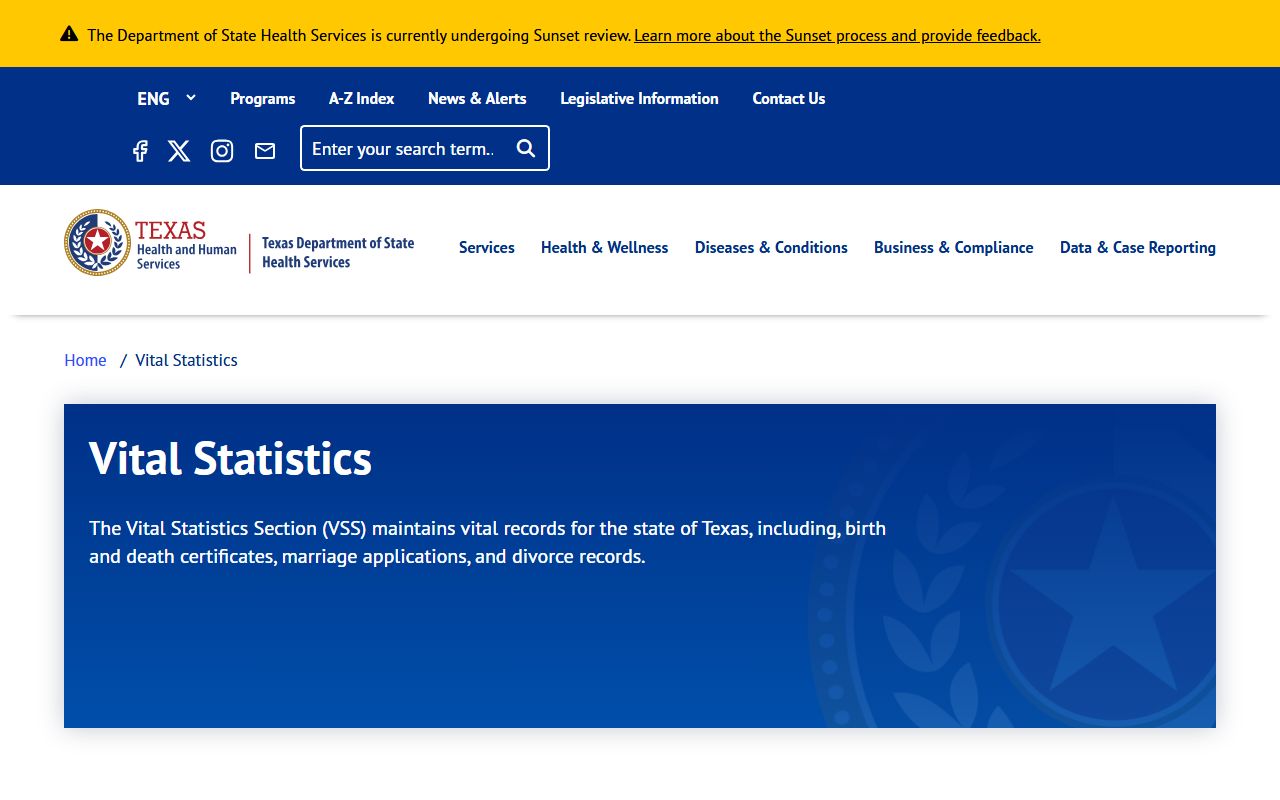
Local county clerk offices in many areas also serve as vital records offices and can issue death certificates.
Historical Probate Court Records in Texas
Older probate court records can be harder to find. Recent cases (less than 50 years old) are usually at the county clerk's office. Files between 50 and 100 years old might be on microfilm or stored off-site. Records over 100 years old often end up at the Texas State Library and Archives Commission (TSLAC). The archives hold historical probate files from many counties, especially ones dating back more than 75 years. TSLAC also has records from defunct or merged jurisdictions.
The Ancestor Hunt directory lists free online Texas probate records organized by county. Many of these come through FamilySearch.org, which has digitized probate minutes, will books, and indexes for dozens of Texas counties. For example, Anderson County has probate case papers from 1846 to 1899. Bowie County has probate minutes from 1889 to 1931. Smith County records go back to 1847. The University of North Texas Portal to Texas History also holds digitized probate documents, including 35 reels of microfilm from the Dallas Genealogical Society.
The screenshot below shows the Ancestor Hunt directory page for free Texas probate records.
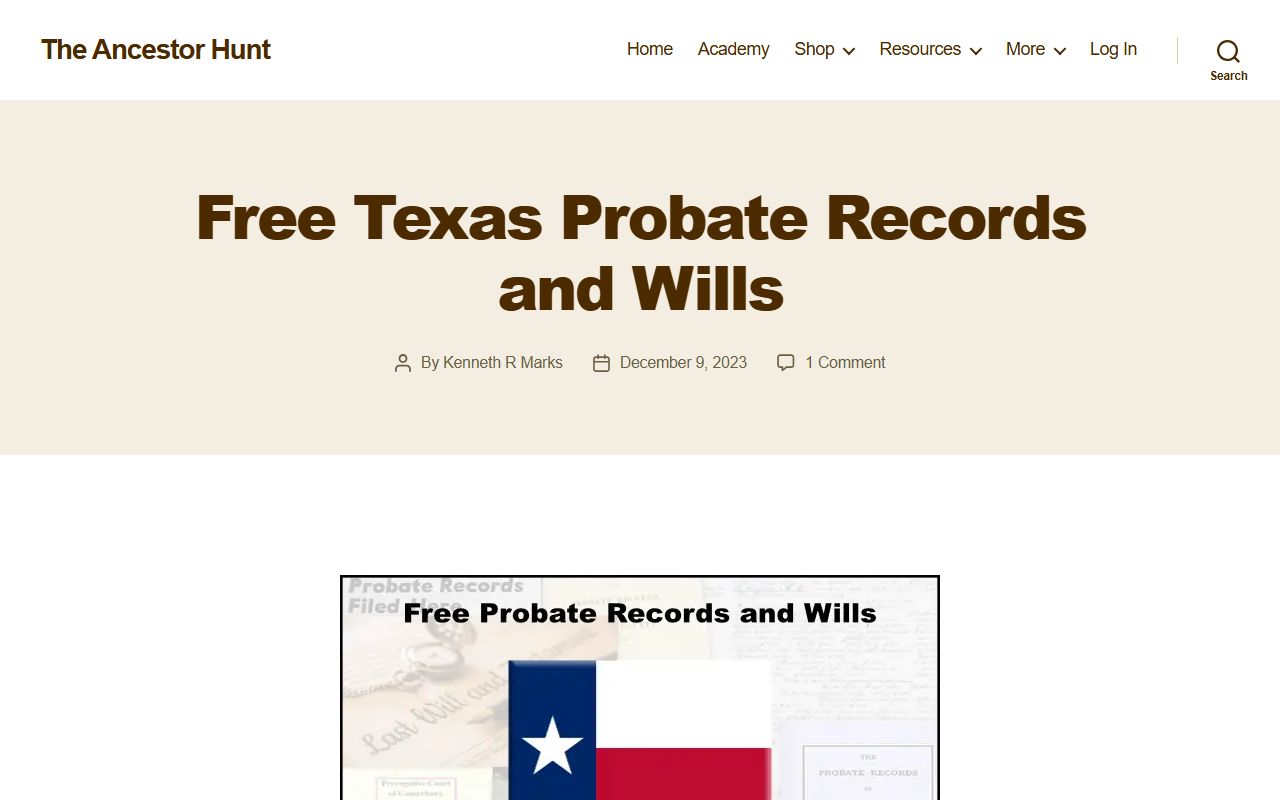
This site links directly to digitized records on FamilySearch and other free databases.
Public Access to Texas Probate Court Records
Texas probate court records are public in most cases. Texas law favors transparency in judicial proceedings. Anyone can go to the courthouse and ask to view or copy probate files. You do not need a lawyer. You do not need to be a party to the case. The public access guide at txprobatelawyer.net explains the process in detail.
Some information gets redacted or restricted. Social Security numbers and bank account numbers are blocked from public view. Medical records and details about minor beneficiaries or guardianship wards may be sealed. Older records might be lost, damaged, or simply not digitized yet. If a case is not online or is more than 15 to 20 years old, your best bet is to contact the county clerk directly. Some records are stored off-site and need a retrieval request, which can take a few days.
When you contact the clerk, have this information ready:
- Full name of the deceased person
- Approximate date of death
- County where they lived
- Case number if you have it
Viewing probate files in person is usually free. Copies cost money. Plain copies run about $1 per page in most counties. Certified copies cost around $5 per document plus the per-page charge. The step-by-step guide on finding Texas probate records walks through the full process from start to finish.
E-Filing for Texas Probate Court Records
The eFileTexas.gov portal is the official statewide e-filing system. It has been mandatory for attorneys filing probate cases since January 1, 2014. People who represent themselves are not required to use it, but they can. The system handles the entire filing process from document submission to fee payment.
The eFileTexas portal is shown below.
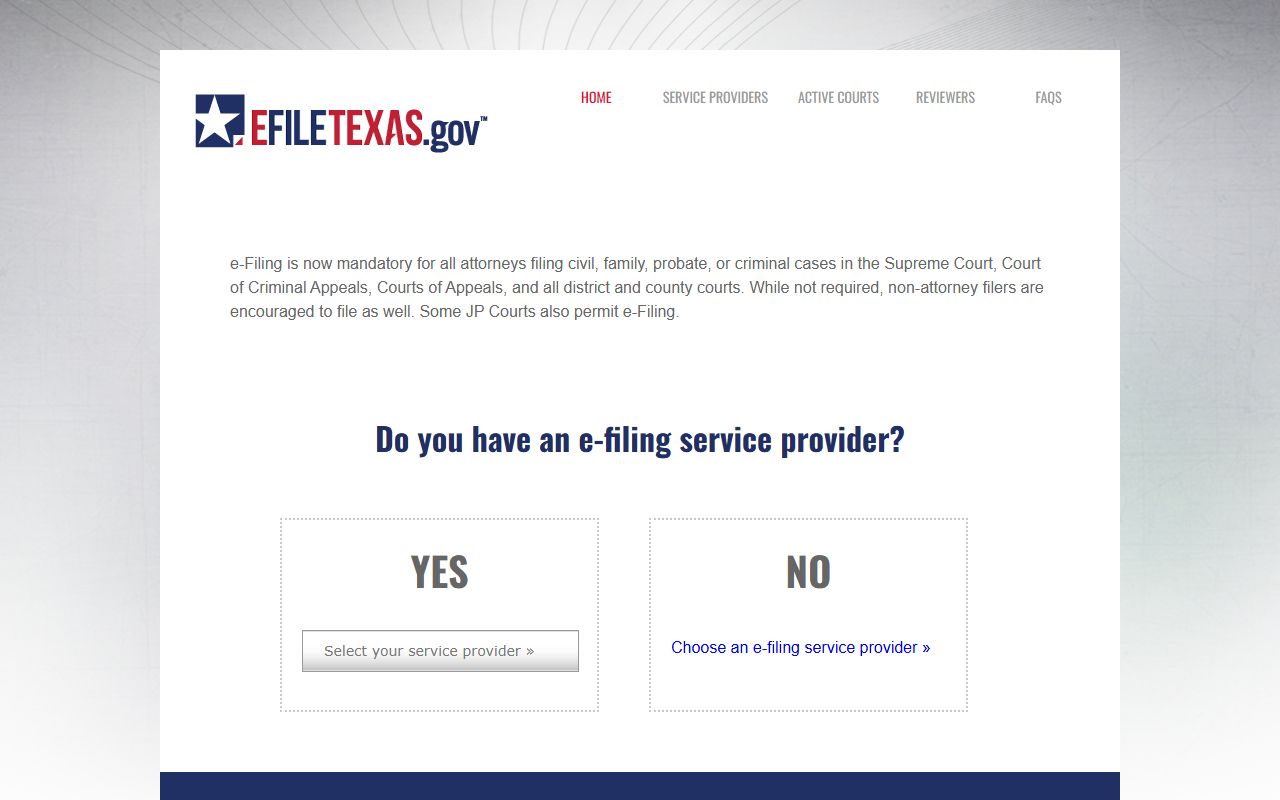
You need to pick an Electronic Filing Service Provider (EFSP) to submit documents. The state charges a $30 electronic filing fee for each new case and $2 per envelope filed. Call 855-839-3453 with questions about the system.
Texas Probate Records Research Resources
The Texas State Law Library is open to the public and can help with probate research. It serves the Texas Supreme Court, the Court of Criminal Appeals, and Texas citizens. The library is in the Tom C. Clark Building at 205 West 14th Street in Austin. Hours are Monday through Friday, 8:00 a.m. to 5:00 p.m. They have research guides on estates and probate topics, plus access to legal databases. A free library account gives you access to their digital collection from home.
The screenshot below shows the Texas State Law Library homepage.
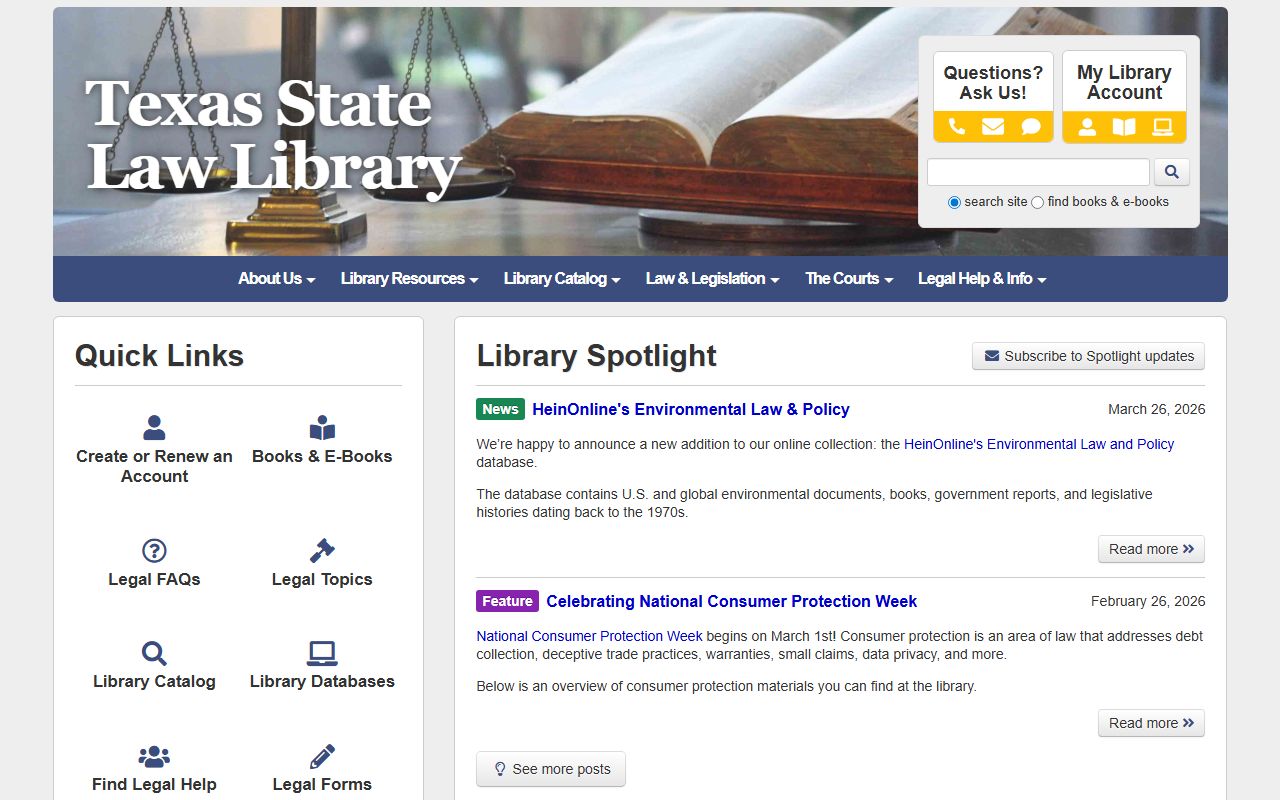
Staff at the library can help you find statutes, court rules, and practice guides related to probate matters in Texas.
The Small Estate Affidavit guide walks through the simplified process for smaller estates. Probate is the number three request for legal aid in Texas. A survey of 1,300 families found that 90 percent did not have wills. Standard probate forms may become available through the Texas Supreme Court after work by the Texas Access to Justice Commission.
Browse Texas Probate Court Records by County
Each of the 254 Texas counties has its own County Clerk who maintains probate court records. Pick a county below to find local contact info, fees, and online search options for probate records in that area.
Probate Court Records in Major Texas Cities
Residents of Texas cities file probate cases at the county court, not a city office. Pick a city below to find out which county handles probate court records for that area.