
Find Dallas County Probate Records
Dallas County probate court records are filed and stored at the County Clerk's office in the George L. Allen, Sr. Courts Building in downtown Dallas. Three statutory probate courts handle estate cases, guardianships, and mental health matters for the county's 2.6 million residents. You can search for probate records through the Dallas County online case portal or make requests in person or by mail. The County Clerk, Hon. John F. Warren, oversees the office that manages these court files. Whether you need a copy of a will, letters testamentary, or a full estate file, the probate division is where you start.
Dallas County Overview
Dallas County Probate Courts
Dallas County has three statutory probate courts. They handle all matters that fall under probate jurisdiction: estates of people who died, guardianships, heirship proceedings, trust disputes, and mental health commitments. The courts are in the George L. Allen, Sr. Courts Building at 600 Commerce Street in Dallas. The building also houses the Central Records Division, which keeps closed probate case files.
Probate records in Dallas County are public under Texas law. That means anyone can ask to see or copy them. You do not need to be a party to the case or have a legal reason. There are some limits. Mental health records are restricted. Guardianship cases involving minors may have sealed portions. Protective orders, personal identifiers like Social Security numbers, and financial records are not open to the public. Adoption files are also restricted.
| Office | Dallas County Clerk - Probate Division |
|---|---|
| Address |
George L. Allen, Sr. Courts Building 600 Commerce Street, B-1 Dallas, TX 75202 |
| Phone | (214) 653-7099 (Central Records Division) |
| Hours | Monday through Friday, 8:00 AM to 4:00 PM |
| DCClosedProbateRec@dallascounty.org | |
| Website | dallascounty.org - County Clerk |
The County Clerk also serves as local registrar for vital records in thirty-one cities within Dallas County. That does not include the City of Dallas itself, which has its own registrar. Property records in the clerk's system go back to 1846.
How to Search Dallas County Probate Records
Dallas County gives you several ways to find probate court records. The main tool is the online case portal. You do not need to create an account. The portal supports smart search and advanced search with location filters. There is even an instructional video on the site that walks you through using it.
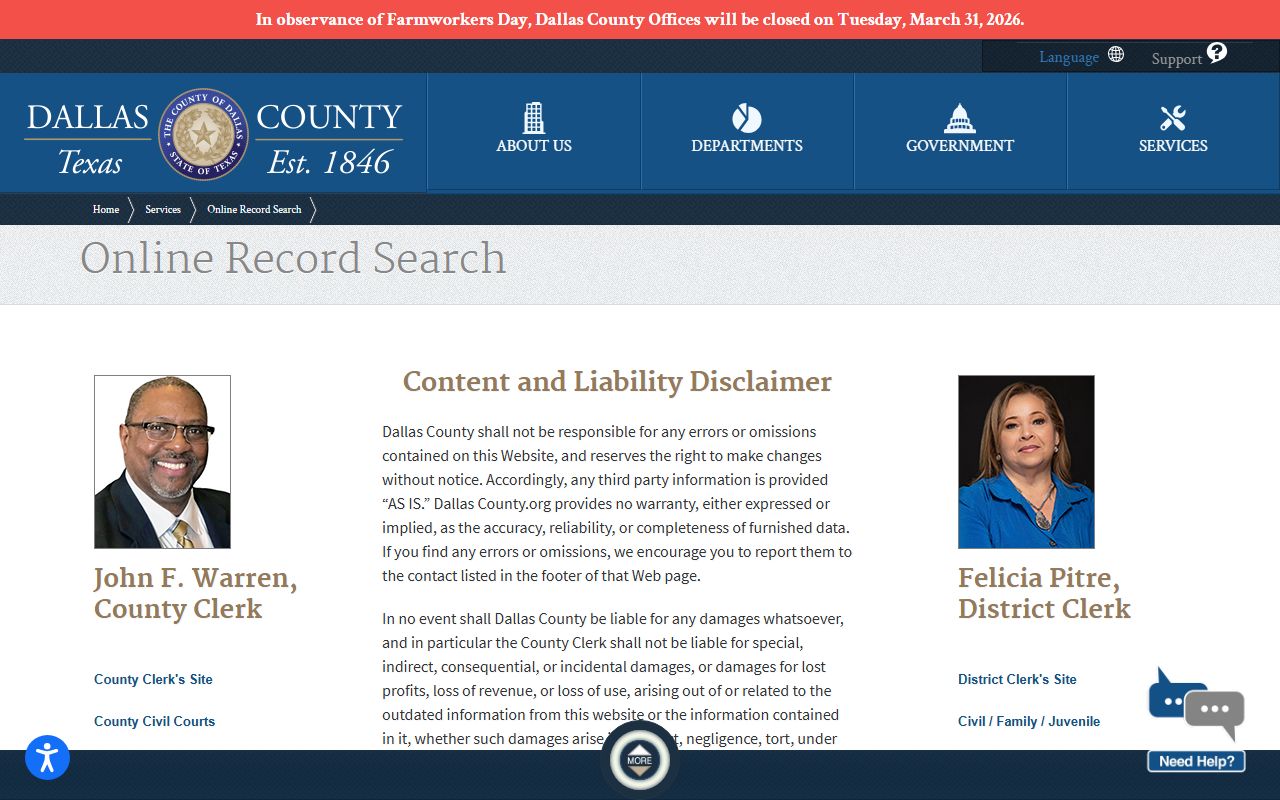
The Dallas County Record Search page directs you to the right database based on your case type. For probate matters, you want the County Clerk Records Search. This covers civil filings, probate cases, and real property records. You can search by full name (last name first) or by case number. Add a first name or middle initial to narrow your results. Date range filters help if you know roughly when the case was filed.
The search results show case numbers, party names, filing dates, case type, and status. You can click into a case for more detail. Online records show case info, disposition events, and some filed documents. Closed probate records are not always on the portal. For those, you need to send a written request to the Central Records Division or go in person. Email your request to DCClosedProbateRec@dallascounty.org with the name, case number, court location, and filing dates.
You can also use re:SearchTX for a statewide search that includes Dallas County cases. The Texas Judicial Branch Court Activity Database has probate case statistics going back to 1992 if you need that kind of data.
Note: Online viewing of Dallas County probate records is free, but copy fees apply if you need physical or certified documents.
Dallas County Probate Fees
Copy costs for Dallas County probate records are straightforward. Paper copies run $1 per page. Certified copies add $5 per document on top of the copy fees. If you mail a request for copies, pay by cashier's check, money order, business check, or attorney's check. The office does not take personal checks by mail.
Filing fees for new probate cases follow the county's fee schedule, which is updated each year. E-filing is required for attorneys. Pro se parties can hand-file. The state e-filing fee is $30 per new case through eFileTexas.gov, and the county charges $2 per envelope. Dallas County also has a Small Estates Help Desk available through the San Antonio Legal Services Association for people who qualify by income.
What Dallas County Probate Records Include
Probate court records in Dallas County contain petitions, applications, wills, and codicils. Court orders, judgments, and letters testamentary are part of the file. You can find estate inventories, asset appraisements, final accountings, and claims against estates. Administration letters and guardianship documents are also kept in the probate files. Each record type serves a different purpose in the estate process.
Under the Texas Estates Code, which replaced the old Texas Probate Code on January 1, 2014, probate proceedings follow specific rules depending on the type of case. Independent administration under Chapter 257 is the most common route. It gives the executor power to manage the estate without going back to court for every step. Dependent administration under Chapters 301 through 309 requires more oversight and creates more records. Heirship proceedings under Chapter 304 determine who inherits when there is no will.
The Dallas Genealogical Society has also transcribed a 60-page index to Dallas County Probate Records. These were put on 35 reels of microfilm and digitized through the University of North Texas Portal to Texas History. Historical probate records for Dallas County are also at the Texas State Library and Archives Commission.
Probate Legal Resources in Dallas County
If you need help with a probate matter in Dallas County, free and low-cost options exist. The State Bar of Texas runs a lawyer referral service at (800) 252-9690. Search for attorneys at texasbar.com.
TexasLawHelp.org has self-help guides covering basic probate procedures. The Texas State Law Library in Austin is open to the public and has research guides on estates and probate law. You can also get a free library account for digital access to their collections. For questions about court rules and local procedures, the Texas Courts Rules and Forms page lists current rules and standing orders for each court in the state.
The guide on finding probate records in Texas walks you step by step through the process. Start by identifying the county, then search the clerk's records online or in person, and check state archives for older cases.
Cities in Dallas County
Dallas County contains several large cities. All probate cases for county residents go through the Dallas County Probate Courts downtown.
Other communities like Balch Springs, Cockrell Hill, Hutchins, and Wilmer are also in Dallas County. All estate and guardianship cases file at the same courthouse.
Nearby Counties
These counties border Dallas County. Under Texas Estates Code Chapter 51, probate is filed in the county where the person lived. Make sure you file in the right place.